

Landing Page vs. Full Website: What Should You Build?
Choose the smallest experience that can support the customer decision without creating a dead end.
A landing page and a full website solve different problems. A landing page creates one focused path for a defined audience and offer. A website supports broader discovery, trust, comparison, multiple services, company information, resources, and ongoing operations. The right choice depends on the decision being asked of the visitor.
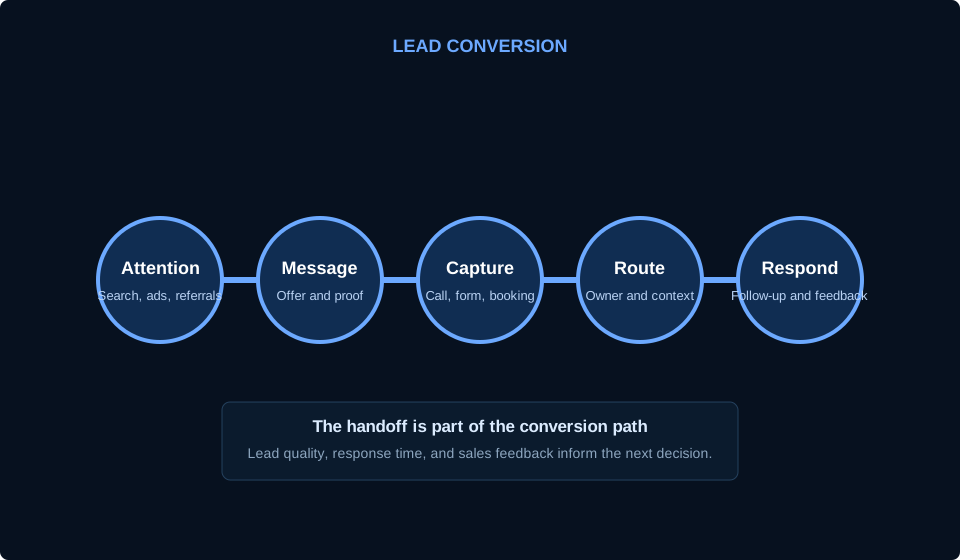
Use a landing page for one controlled decision
A landing page fits a specific campaign, audience, service, location, event, or offer with one primary action. It works best when the traffic source and visitor intent are known, the proof is focused, and the business has a dependable process after the call or form.
The page still needs identity, privacy, accessible forms, truthful claims, mobile performance, analytics, thank-you behavior, and an appropriate route back to the company. A short page is not permission to remove the information a customer needs to make a safe decision.
Defined traffic
The audience arrives from a known campaign, referral, email, QR code, event, or narrow search intent.
Single offer
One service or action deserves primary focus without forcing visitors through unrelated navigation.
Ready follow-up
Calls, forms, booking, qualification, consent, routing, and response ownership are already understood.
Use a full website for broad trust and discovery
A full website fits a business with multiple services, audiences, locations, proof types, resources, support needs, or organic search goals. It gives customers room to compare options, understand the company, review work, answer objections, and choose the right next step.
The website should still prioritize key journeys. More pages do not automatically create more value. Build a clear core and add services, locations, projects, and resources when each page carries unique information and a responsible owner.
Multiple decisions
Customers need to compare services, project fit, locations, approaches, evidence, and contact options.
Organic visibility
The business needs useful, indexable pages connected by a coherent information architecture.
Ongoing operations
The site supports recruiting, support, resources, updates, customer accounts, or multiple conversion paths.
Often the best answer is both
A strong website can act as the trust and discovery foundation while focused landing pages support specific campaigns. Reuse the same verified company facts, design system, analytics governance, and lead-handling process so campaign pages do not become disconnected microsites.
Create landing-page variants only when there is a real hypothesis: different audience, offer, proof order, form length, or message. Preserve canonical and indexing decisions so temporary paid pages do not compete with the durable service content unless that is intentional.
Shared foundation
Identity, legal pages, analytics, forms, performance, accessibility, and brand components come from one governed system.
Purposeful variants
Each landing page names its traffic source, audience, message, action, measurement, and expiration or review date.
Lead feedback
Campaign reporting includes qualification and operational feedback, not only clicks and form counts.
Make the decision with a simple test
Choose a landing page when one audience can make one well-supported decision and the rest of the business already has a credible home. Choose a website when visitors need to discover, compare, verify, or navigate multiple paths. Choose both when a durable website needs controlled campaign experiences.
Before building, write the audience, source, promise, proof, action, response owner, recurring costs, and success measure on one page. If those cannot be stated clearly, the problem is not the page format yet. It is the offer or operating process.
Decision complexity
Count the distinct audiences, services, objections, proof needs, and next actions the experience must support.
Traffic strategy
Separate temporary campaigns from durable search, referral, direct, customer, and recruiting journeys.
Operating readiness
Confirm the business can respond, fulfill, measure, and maintain what the page promises.
Use this before the next decision.
- Audience and traffic source are known
- One primary action is defined
- Proof supports the exact offer
- Lead handling is ready
- Indexing and canonical intent are decided
- Analytics excludes personal form content
- The page has an owner and review date
- Recurring provider costs are understood
Related guides
Choose the right build before choosing the page builder.
Use the HostAvvy growth planner to connect the offer, website foundation, campaign path, lead routing, and measurement needs.